Laminating puff pastry in Singapore heat
Butter starts to soften at the temperature of an ordinary Singapore afternoon. You can still make flaky puff pastry at home: you just have to plan around the weather.
Quick answer
To laminate puff pastry in Singapore, work when the kitchen is coolest, keep butter and dough at the same cold-but-bendable firmness, rest the dough in the fridge for 30 minutes after every one or two folds, roll fast with minimal flour, and chill or freeze the shaped pies before baking so the butter layers are firm when they meet a hot oven.
Why is laminating hard in Singapore?
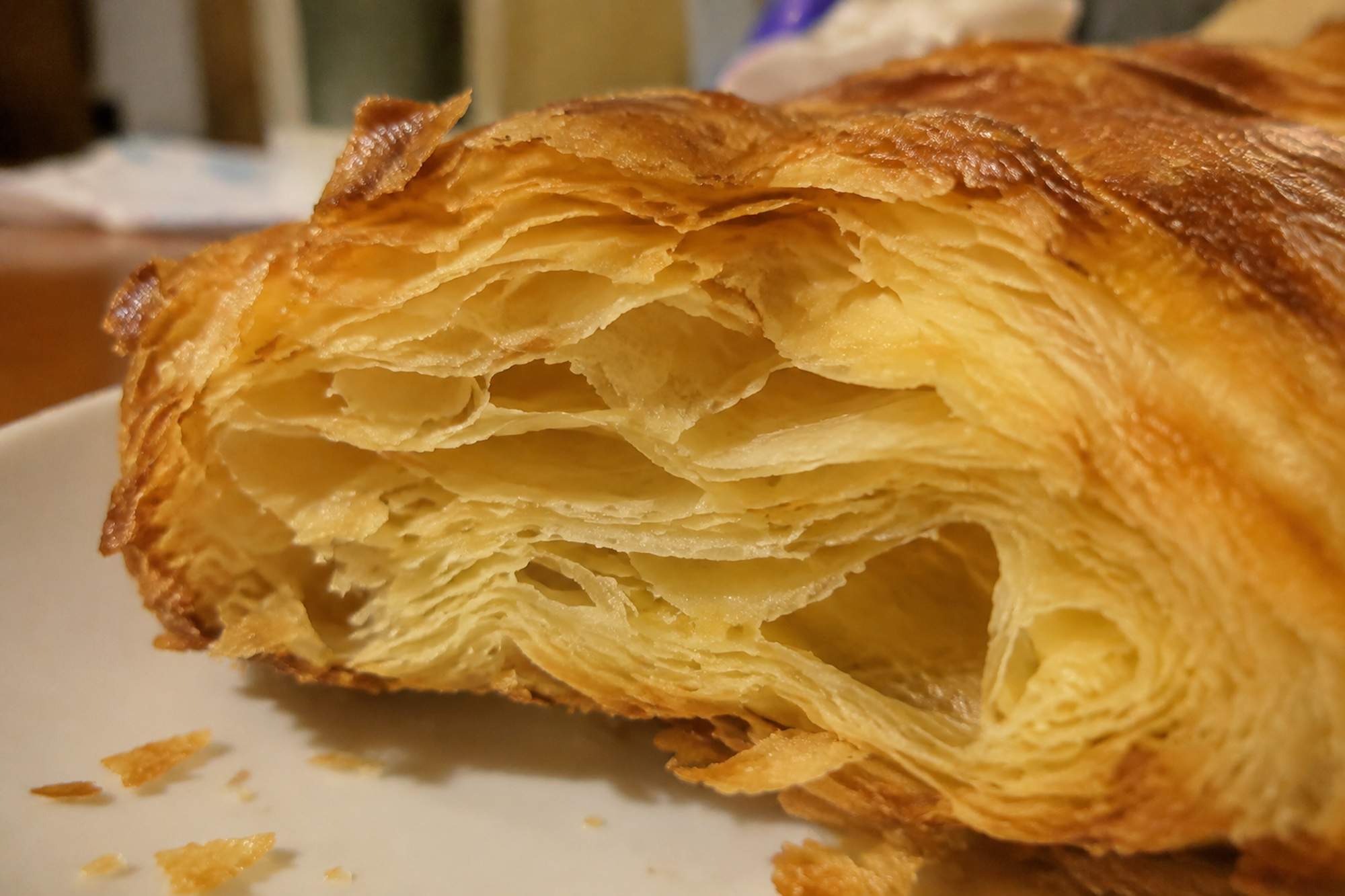
Laminated pastry only works while the butter stays in sheets. If the term is new, chickenpie.net’s glossary has a clear, general definition of lamination in pastry; this guide is about what changes when the kitchen is 30 C. Butter softens quickly as it warms, and an ordinary Singapore kitchen without aircon sits around 30 C for much of the day. At that temperature, a sheet of butter inside a sheet of dough has only minutes before it stops behaving like a solid. Once soft, it smears into the dough instead of separating from it, and the pastry bakes up bready rather than flaky.
Professional kitchens solve this with cold rooms and chillers. A Hainanese pastry chef at M Hotel described shaping his butter puff pies and then resting them at 1 to 3 C for about two hours before baking, precisely because butter melts in the local heat (Hong Leong Hi-Life magazine, 2018). Chef Johnny Ngiam made all-butter puff by hand in a small shop kitchen for years (ieatishootipost, 2013), which, having tried it at home, I now regard as a quiet feat.
When is the best time to laminate?
Early. The coolest part of the day in most HDB flats is before the sun hits the walls. I start the dough the night before, so it is cold right through, and do the folds between 7am and 9am. If you have aircon, run it in the kitchen for half an hour before you start, and close the door.
What equipment helps?
- A cold surface. Marble, granite or a steel tray straight from the fridge. Wooden boards hold heat.
- A long, straight rolling pin without handles, so your warm hands stay away from the dough.
- A ruler. Rough puff wants a rectangle about three times as long as it is wide. Measuring stops you rolling it too thin in one corner.
- A pastry brush to sweep off excess flour before each fold. Flour trapped between layers makes the pastry tough.
- Space in the fridge for a flat tray, and ideally a corner of the freezer.
What is the routine, step by step?
- Chill everything. Flour, butter cut into cubes, and the water with a few ice cubes in it. Even the mixing bowl can go in the freezer for ten minutes.
- Mix fast. Rub or cut the butter into the flour only until it is in flattened lumps the size of your thumbnail, then add just enough iced water to bring it together. Visible streaks of butter are what you want.
- Rest 30 minutes. Wrap and chill. This lets the flour hydrate and the gluten relax, and firms the butter again.
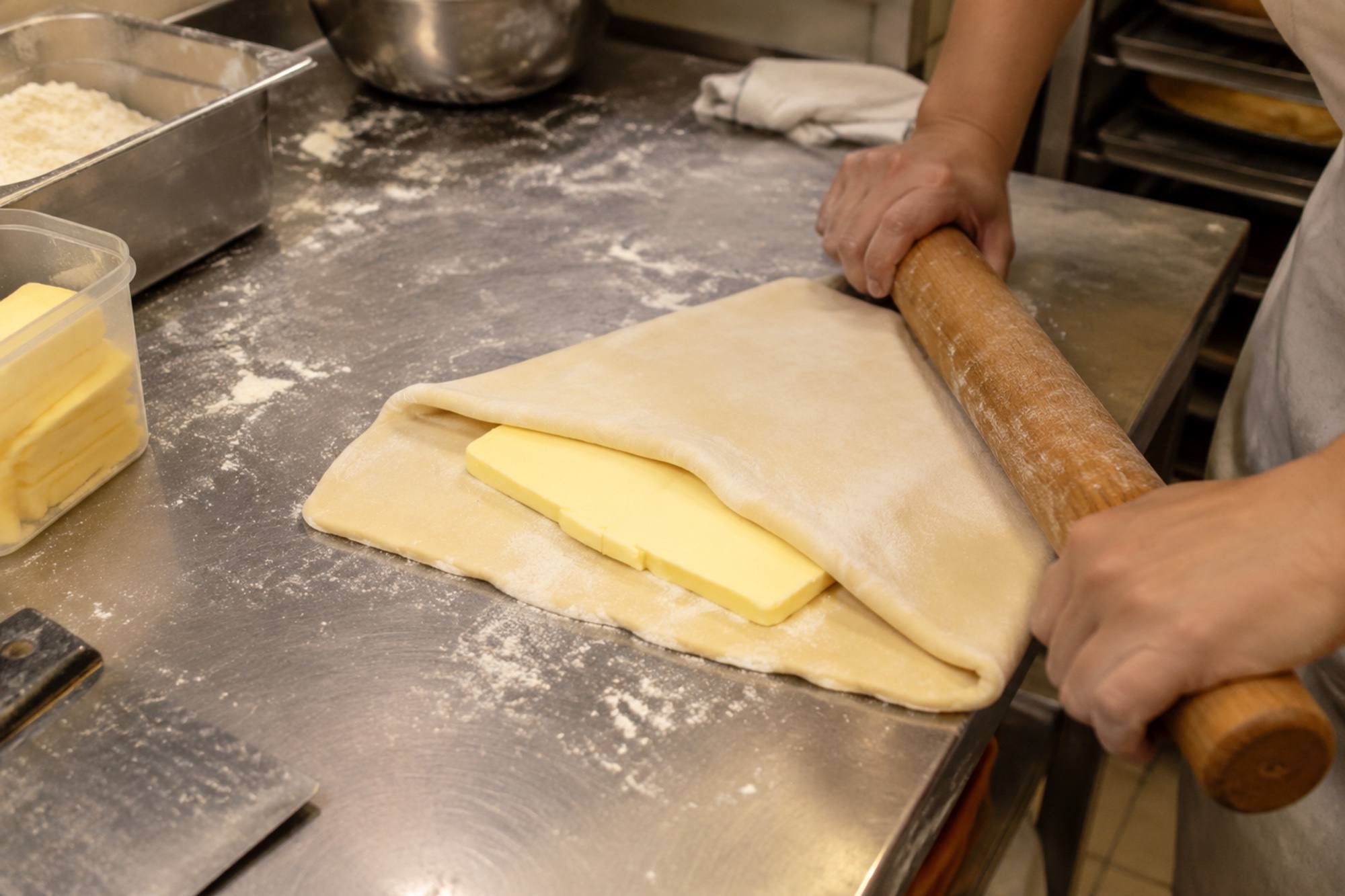
- Roll and fold. Roll into a long rectangle, brush off flour, fold in thirds like a letter. Turn it a quarter. That is one turn.
- Rest again. In Singapore I rest after every single turn for the first two, then after every pair. The Singapore Noodles rough puff I adapted chills for 30 minutes between folds (Singapore Noodles), which matches my experience.
- Stop at four turns for rough puff. More is not always better; see the counter below.
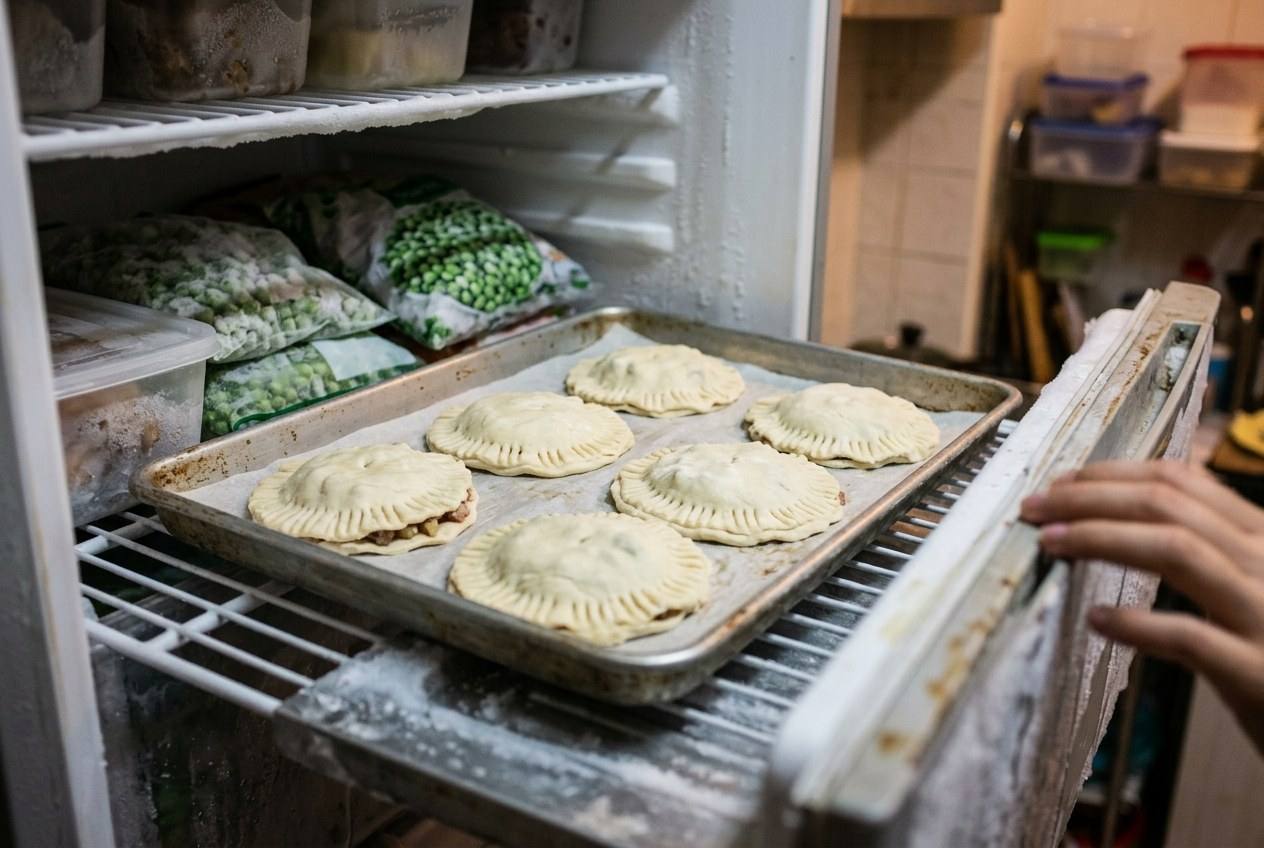
- Shape, then chill again. Cut and fill the pies, then chill them for at least 30 minutes in the fridge, or 15 minutes in the freezer, before they go into the oven.
How many folds do I need?
The counter shows what each fold does. For a flat chicken pie, four letter folds of rough puff give plenty of layers. Full puff pastry for a tall vol-au-vent might get six.
The lamination counter
Puff pastry rises because thin sheets of butter separate thin sheets of dough. Each fold multiplies the butter sheets. Pick a fold and a number of turns and the counter does the arithmetic.
1 × 3 × 3 × 3 × 3 = 81 butter sheets
- Butter sheets
- 81
- Dough sheets
- 82
- Layers in total
- 163
Four letter folds: the rough puff in my recreations. Real rough puff has butter in flattened lumps, not a perfect sheet, so treat this number as a ceiling.
| Folding | Arithmetic | Butter sheets | Total layers |
|---|---|---|---|
| Croissant dough, three letter folds | 1 × 3 × 3 × 3 | 27 | 55 |
| My rough puff, four letter folds | 1 × 3 × 3 × 3 × 3 | 81 | 163 |
| Two book folds then one letter fold | 1 × 4 × 4 × 3 | 48 | 97 |
| Classic puff pastry, six letter folds | 1 × 3 × 3 × 3 × 3 × 3 × 3 | 729 | 1,459 |
| Four book folds | 1 × 4 × 4 × 4 × 4 | 256 | 513 |
Why dough sheets are one more than butter sheets: when you fold, the dough on the outside of one layer presses against the dough of the next and they fuse, so every butter sheet ends up with dough on both sides and nothing else. That is the same reason six letter folds are usually quoted as 729 butter layers and not 1,458.
What is the chill-before-baking trick?
This is the most useful single habit for puff pastry in the tropics. Pastry warms up while you shape it: rolling, cutting, filling, crimping, glazing. By the time a tray of pies is ready, the butter layers at the edges are often soft. If they go into the oven like that, the butter runs out before the steam can lift the layers, and you get a puddle and a flat, greasy edge.
Chilling the shaped pies fixes it. The M Hotel chef’s two hours at 1 to 3 C (Hong Leong Hi-Life magazine, 2018) is the professional version. At home, 30 minutes in the fridge or 15 minutes in the freezer is usually enough for small flat pies. The pastry should feel firm, almost stiff, when you take it out. Then it goes straight onto a preheated tray in a fully hot oven.
What goes wrong, and how do I fix it?
| What you see | Likely cause | What to do |
|---|---|---|
| Butter breaks through the dough while rolling | Butter too cold and brittle, or dough too thin there | Patch with a pinch of flour, chill 15 minutes, roll more gently |
| Dough turns greasy and sticky | Butter has softened | Stop. Wrap and chill 30 minutes. Do not add flour to rescue it |
| Dough springs back when rolled | Gluten is tight | Rest longer between turns |
| Butter pools on the tray in the oven | Pastry was warm when baked, or oven not hot | Chill the shaped pies; preheat fully; bake on a hot tray |
| Layers fused, pastry bready | Butter smeared into dough during folding | Work faster and colder; fewer folds per session |
| Pale, soft bottom | Wet filling, warm filling, or no heat from below | Cool the filling fully; bake on a preheated tray on the lowest shelf |
Is it worth making puff pastry at all?
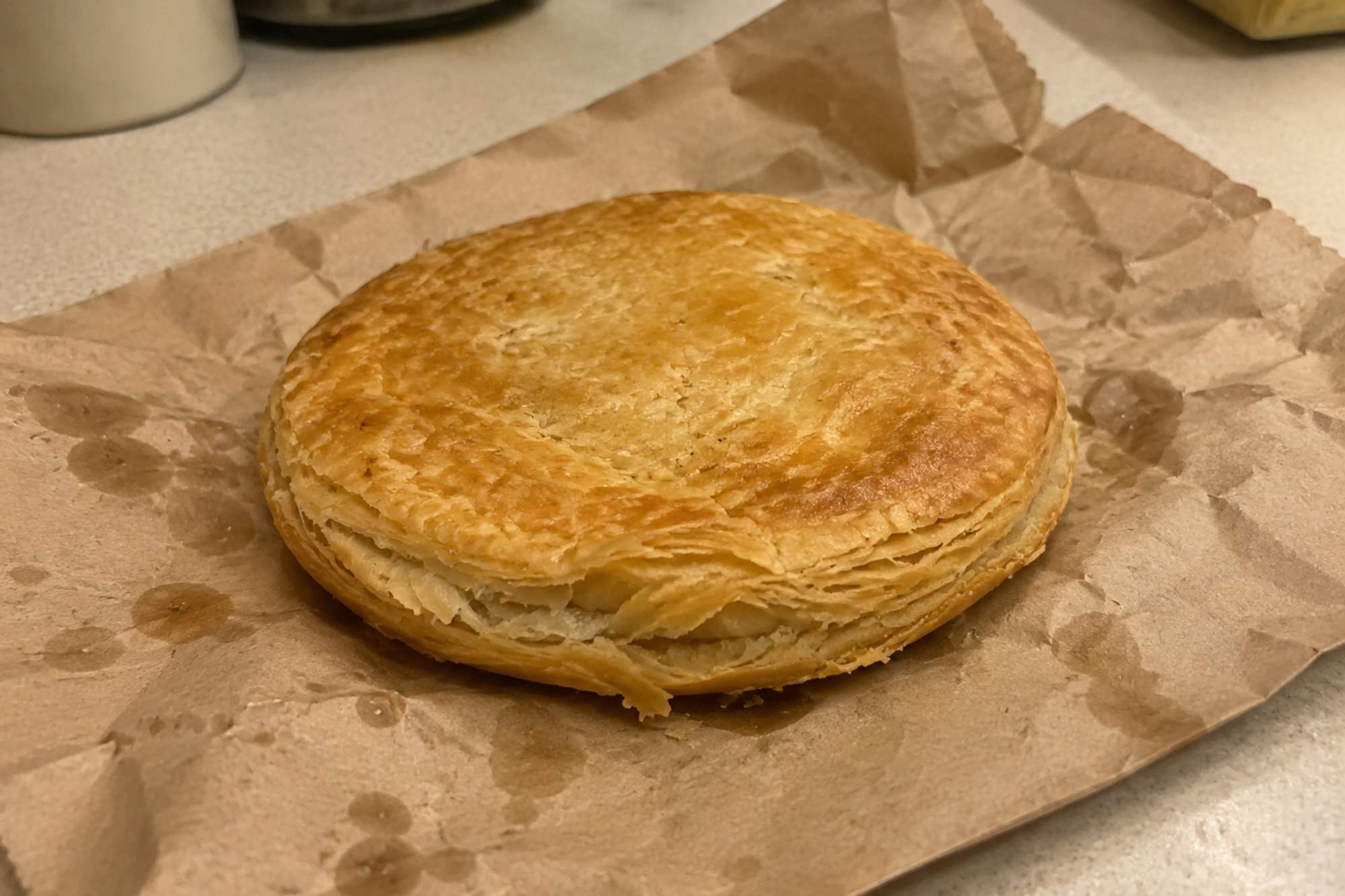
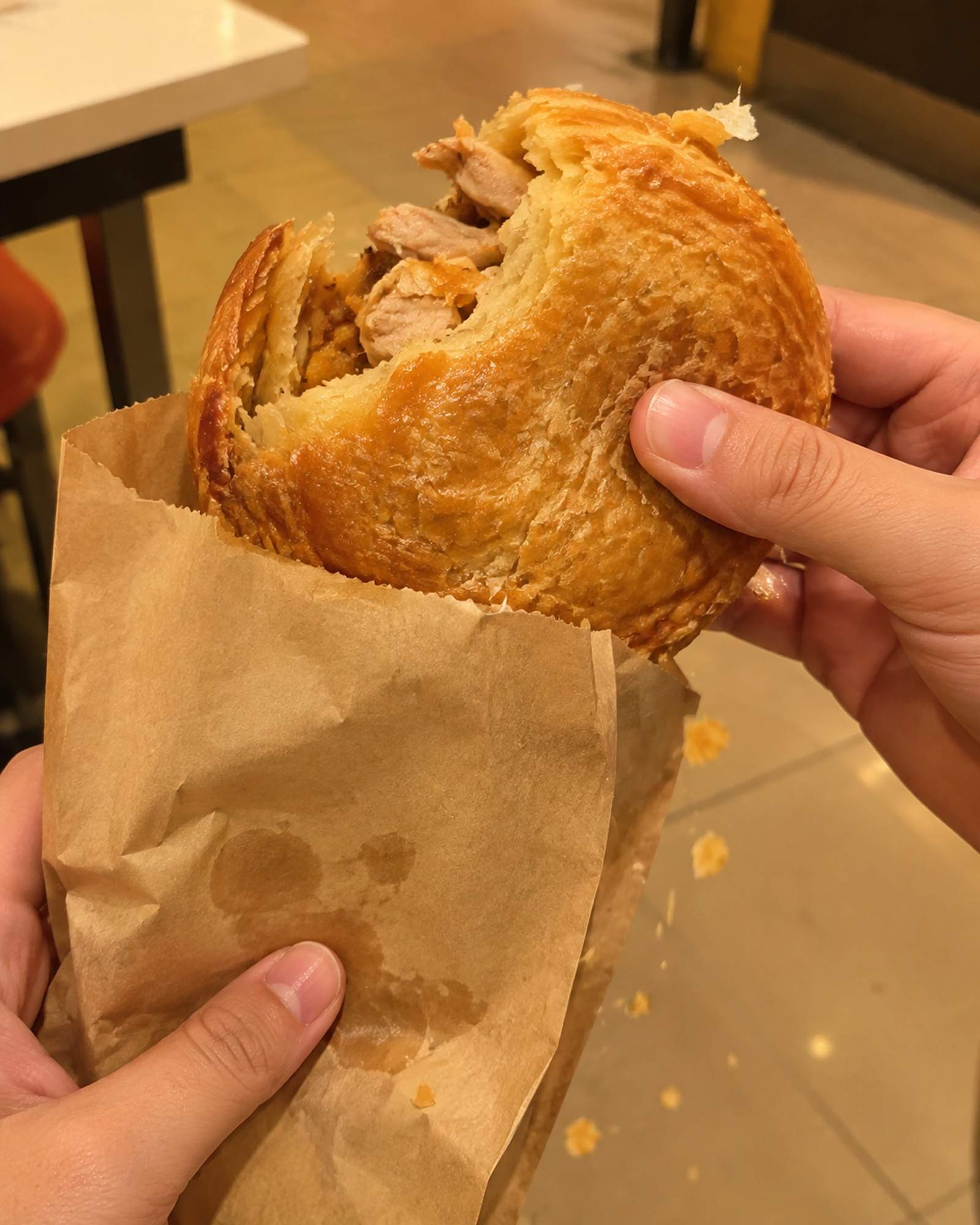
For the Oven Marvel pie, I think so. The thing reviewers kept noticing was the butter (ieatishootipost, 2013), and you can only control that if you make the pastry. But a good all-butter bought puff gets you much of the way there on a weeknight; see the weeknight recreation. When you are ready to go the whole way, the rough puff pastry recipe has timers built into the steps, and the butter puff chicken pie recreation shows where the pastry ends up. The other technique guides pick up from there: the filling, the pepper and the reheat.
Questions people ask
Can you make puff pastry in a hot kitchen?
Yes, with more chilling. Rest the dough in the fridge for 30 minutes after every fold or two, roll quickly, and chill the shaped pastry before baking. Aircon helps a great deal but is not essential.
How cold should butter be for laminating?
Cold enough to stay solid, soft enough to bend without cracking. Press it with a finger: it should dent slowly without going greasy. Butter straight from a very cold fridge often cracks and needs a few minutes of bashing with a rolling pin.
Why does my puff pastry leak butter in the oven?
Usually because the butter layers were soft when the pastry went in, so the butter melted and ran out before the dough could set. Chill the shaped pies thoroughly, bake on a preheated tray, and make sure the oven is fully hot.
Sources for this page
- The art of the chicken pie at M Hotel
- Eurasian chicken pie
- Oven Marvel: super duper addictive chicken pies
- Oven Marvel at Sunshine Plaza: reviews
Every source we used, with notes on what each one says: sources and further reading.
Keep reading